This is an old revision of the document!

Lab Documents
Download the Lab documents here!Experiment 4: Alternating Voltage
Objectives of the Experiment
Getting to know
- sinusoidal quantities, active (real), reactive, and apparent resistance/impedance, phasor diagrams
- behavior of an RC and RL series circuit with different passive components at constant frequency
- low-pass filter (behavior of an RC circuit at different frequencies)
- RLC series resonant circuit: voltage across the resistor and impedances at different frequencies
Applying
- voltage analysis in the time domain using a simulation program
Alternating Current Circuits: Capacitors and Inductors
Sinusoidal quantities
figure 1 shows the waveforms of a sinusoidal voltage $u(t) = \hat{U} \cdot \sin(\omega t + \varphi_{\rm u})$ and a sinusoidal current $i(t) = \hat{I} \cdot \sin(\omega t + \varphi_{\rm i})$:

- $\omega = 2\pi f$ is defined as the angular frequency and has the unit $1/s$
- $\hat{I}$ is referred to as the peak value or amplitude of the current
- $I$ is the RMS (effective) value of the current
In alternating current systems, the RMS value is defined as the value that produces the same amount of heat in a purely resistive load as a direct current of the same magnitude.
The crest factor is defined as the ratio of the peak value to the RMS value:
$$c = \frac{\hat{I}}{I} = \frac{\hat{U}}{U}$$
For sinusoidal quantities, $c = \sqrt{2}$.
$\varphi = \varphi_{\rm u} - \varphi_{\rm i}$ is called the phase displacement angle or simply the phase shift.
Given a two-terminal network (a) with the corresponding phasor diagram (b), s.
figure 2.
Sketch the time variation of current and voltage, clearly indicating the phase shift.

In alternating current circuits, a two-terminal network is characterized by its impedance or complex resistance $Z$.
$Z = R + jX$, where $R$ is the real (active) resistance and $X$ is the reactive resistance.
The magnitude of the impedance (apparent resistance) is $Z = \sqrt{(R^2 + X^2)}$, s. figure 3.

The following relationships hold:
$$R = Z\cdot \cos\varphi, ~~~ X = Z\cdot \sin\varphi, ~~~ \varphi = \arctan\frac{X}{R}$$
Similar to Ohm’s law, for sinusoidal quantities the following applies: $$Z = \frac{U}{I}$$
Experiment 1: Series Circuit of a Resistor and a Capacitor
Assemble the measurement circuit shown in figure 4:

The corresponding phasor diagram is also illustrated in figure 4.
The apparent resistance (impedance) of a capacitor depends on the frequency. The capacitive reactance is given by:
$$X_{\rm C} = \frac {1}{ωC}$$
For a series connection of a resistor and a capacitor, the magnitude of the impedance is calculated as:
$$Z = \sqrt{R_{\rm 1}^2 + \frac{1}{(ωC_{\rm 1})^2}}$$
Adjust the function generator to output a sinusoidal voltage with a frequency of 6 kHz and an amplitude of 6 V. Measure both the frequency and the amplitude using the oscilloscope.
Sketch the time-domain waveforms of the voltages $u_{\rm F}$ and $u_{\rm C}$, clearly indicating the phase shift between them.
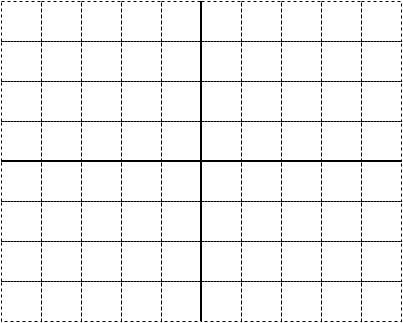 Fig. 5
Channel 1: $ \frac{V}{\rm DIV} = $
Channel 2: $ \frac{V}{\rm DIV} = $
Time basis: $ \frac{T}{\rm DIV} = $
Using the measured values, draw the phasor diagram. Based on the given component values $R_{\rm 1}$, $C_{\rm 1}$, and the source voltage amplitude $\hat{U}_{\rm F}$, calculate the impedance $Z$, the current amplitude $\hat{I}$, and the voltage amplitudes $\hat{U}_{\rm R}$ and $\hat{U}_{\rm C}$. Compare the calculated results with the measured values.
Repeat this experiment using a capacitor with a capacitance of 1 µF
Fig. 6
Channel 1: $ \frac{V}{\rm DIV} = $
Channel 2: $ \frac{V}{\rm DIV} = $
Time basis: $ \frac{T}{\rm DIV} = $
Draw the corresponding phasor diagram using the newly measured values:
Experiment 2: Series Circuit of a Resistor and an Inductor
Assemble the measurement circuit shown in figure 7:

The corresponding phasor diagram is also illustrated in figure 7.
The apparent resistance of an inductor is frequency-dependent. The inductive reactance is given by:
$$X_{\rm L} = \omega \cdot L$$
For a resistor and an inductor connected in series, the impedance magnitude is calculated as: $$Z = \sqrt{R_{\rm 1}^2 + (ωL_{\rm 1})^2}$$
Set the function generator to produce a sinusoidal voltage with a frequency of 6 kHz and an amplitude of 6 V. Measure the amplitude and frequency using the oscilloscope.
Sketch the time-domain waveforms of the voltages $u_{\rm F}$ and $u_{\rm L}$, clearly indicating the phase shift between them.
Fig. 8
Channel 1: $ \frac{V}{\rm DIV} = $
Channel 2: $ \frac{V}{\rm DIV} = $
Time basis: $ \frac{T}{\rm DIV} = $
Draw the phasor diagram using the measured values. From the known component values $R_{\rm 1}$, $L_{\rm 1}$, and the source voltage amplitude $\hat{U}_{\rm F}$, calculate the impedance $Z$, the current amplitude $\hat{I}$, and the voltage amplitudes $\hat{U}_{\rm R}$ and $\hat{U}_{\rm L}$. Compare the calculated results with the measured values.
Repeat this using an inductor with an inductance of 10 mH
Fig. 9
Channel 1: $ \frac{V}{\rm DIV} = $
Channel 2: $ \frac{V}{\rm DIV} = $
Time basis: $ \frac{T}{\rm DIV} = $
Draw the corresponding phasor diagram based on the measured data.
Experiment 3: R–C Circuit as a Low-Pass Filter
Assemble the R–C measurement circuit shown in figure 10:

The circuit can be interpreted as a voltage divider. With increasing frequency, the capacitive reactance of capacitor $C_{\rm 1}$ decreases, which leads to a reduction in the amplitude of the output voltage $u_{\rm 2}$. The ratio of the output voltage to the input voltage as a function of frequency is called the transfer function:
$$F(j\omega) = \frac {U_{\rm 2}}{U_{\rm 1}}$$
Applying the voltage divider rule yields the following expression for the transfer function:
$$F(j\omega) = \frac {U_{\rm 2}}{U_{\rm 1}} = \frac{\frac{1}{j\omega C_{\rm 1}}}{R_{\rm 1}+\frac{1}{j\omega C_{\rm 1}}} = \frac{1}{1+j\omega C_{\rm 1}R_{\rm 1}}$$
The transfer function depends on the angular frequency ($\omega = 2\pi \cdot f$) and can be expressed in terms of magnitude and phase.
The magnitude $|\frac{U_{\rm 2}}{U_{\rm 1}}| = \frac{1}{\sqrt 1+(\omega R_{\rm 1}C_{\rm 1})^2}$ is referred to as the amplitude response.
The phase angle $\varphi$ between the input voltage $u_{\rm 1}$ and the output voltage $u_{\rm 2}$ is called the phase response. The following relation applies:
$$\varphi_{\rm U_{\rm 2}}=−\arctan\omega R_{\rm 1}C_{\rm 1}$$
The cutoff angular frequency $\omega_{\rm G}$ is defined as the frequency at which the following conditions apply to the amplitude ratio $\frac{U_{\rm 2}}{U_{\rm 1}}$ and the phase angle $\varphi$:
$$\frac{U_{\rm 2}}{U_{\rm 1}}=\frac{1}{\sqrt2}, ~~~ \varphi=−45°$$
Calculate the cutoff angular frequency for the given filter.
$\omega_{\rm G}$ = ……………………………..
From this, the cutoff frequency follows as
$f_{\rm G}$ = ………………………
Measure the amplitude response of the low-pass filter.
The sinusoidal input voltage generated by the function generator shall have an amplitude of 6 V. The voltages $u_{\rm 1}$ and $u_{\rm 2}$ to be measured are connected to the channels of the oscilloscope.
Use the measured and calculated values to complete table 1.

Draw the amplitude response on the provided logarithmic graph paper.
Experiment 4: R–L–C Series Resonant Circuit
“Resonance describes the oscillatory response of a system when it is excited by a frequency that matches or is close to the system’s natural frequency.”
Set up the following measurement circuit:

The corresponding phasor diagram is shown in figure 11.
The function generator shall be set to produce a sinusoidal signal, and the amplitude of the output voltage shall be 6 V. For the circuit shown above, the magnitude of the impedance is given by:
$$Z = \sqrt{R^2 + (\omega L − \frac{1}{\omega C})^2}$$
As can be seen from figure 11, the inductive and capacitive voltage components partially cancel each other. There exists a specific frequency at which these components cancel completely, causing the circuit to behave as a purely resistive circuit. This frequency is known as the resonance frequency.
The resonance frequency is given by:
$$f_{\rm r} = \frac{1}{2\pi \sqrt{LC}}\text{, or} ~~~ \omega_{\rm r} = \frac{1}{\sqrt{LC}}$$
At resonance, the current is given by:
$$I = \frac{U}{R}$$
Calculate the resonance frequency for the assembled measurement circuit.
(The capacitance of the capacitor is determined using a measuring instrument)
$f_{\rm r}~=~ ..........................................................$
Adjust the frequency of the function generator so that the ratio $\frac{f}{f_{\rm r}}$ corresponds to the values listed in table 2. Measure the RMS voltage $U_{\rm R}$ using the oscilloscope and record the measured values in table 2.

Plot the current as a function of the ratio $\frac{f}{f_{\rm r}}$ on a logarithmic scale.
Preparation for the Oral Short Quiz

For this experiment you should
- be able to apply and explain the following concepts:
- phasor representation
- of harmonic signals
- of impedance quantities
- complex impedance operators (e.g. $j \cdot X_L$)
- cutoff frequency
- series resonant circuit
- different voltages $U_R$, $U_C$, $U_L$ for $f\rightarrow 0$ and $f\rightarrow \infty$
- graphical and computational determination of the complex impedance $\underline{Z}$ of the circuit
- behavior of $\underline{Z}$ at different frequencies
- definition, behavior, and calculation of the resonance frequency
- relationship between resonant circuit and antenna (see figure 12)
- consider the circuit when, instead of the voltage across the resistor $U_R$, the output voltage across the capacitor $U_C$ is measured.
- What is this circuit called?
- What is it used for?
- What output voltage results for $f\rightarrow 0$ and $f\rightarrow \infty$?